Driving on Ko Lanta: A First-Timer's Guide
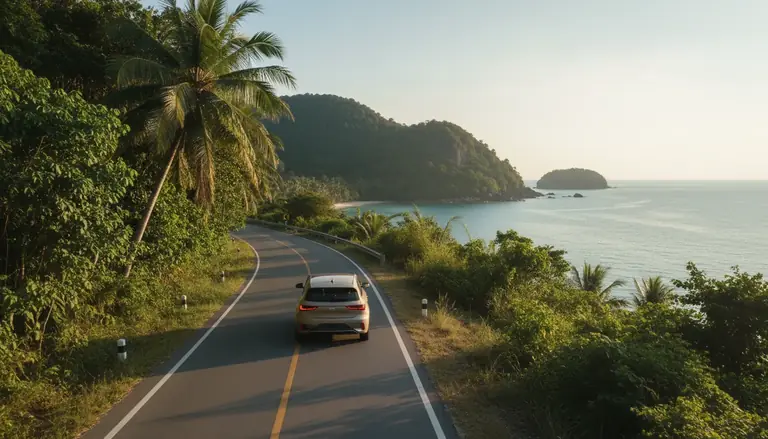
Thailand drives on the LEFT, and Ko Lanta's main west-coast road is flat and easy from Saladan down to Klong Nin — but south of there it turns steep, narrow and winding all the way to the national park.
Compare Car Rental DealsSearch & Compare Car Rental Deals
Free cancellation on most vehicles
The Island's Roads
Ko Lanta Yai has no road bridge to the mainland. To drive onto the island, you take Highway 4 from Krabi, turn onto Highway 4206 toward the Ban Hua Hin car-ferry pier, and roll your vehicle onto a short roll-on/roll-off ferry. Once on Ko Lanta Noi you drive roughly 9 km south and cross the Siri Lanta Bridge — opened in April 2016 — onto Ko Lanta Yai. The mainland ferry runs from around 5 am to midnight with three or four boats in high season, so the crossing itself is quick and straightforward. A direct mainland bridge has been discussed for years but does not yet exist.
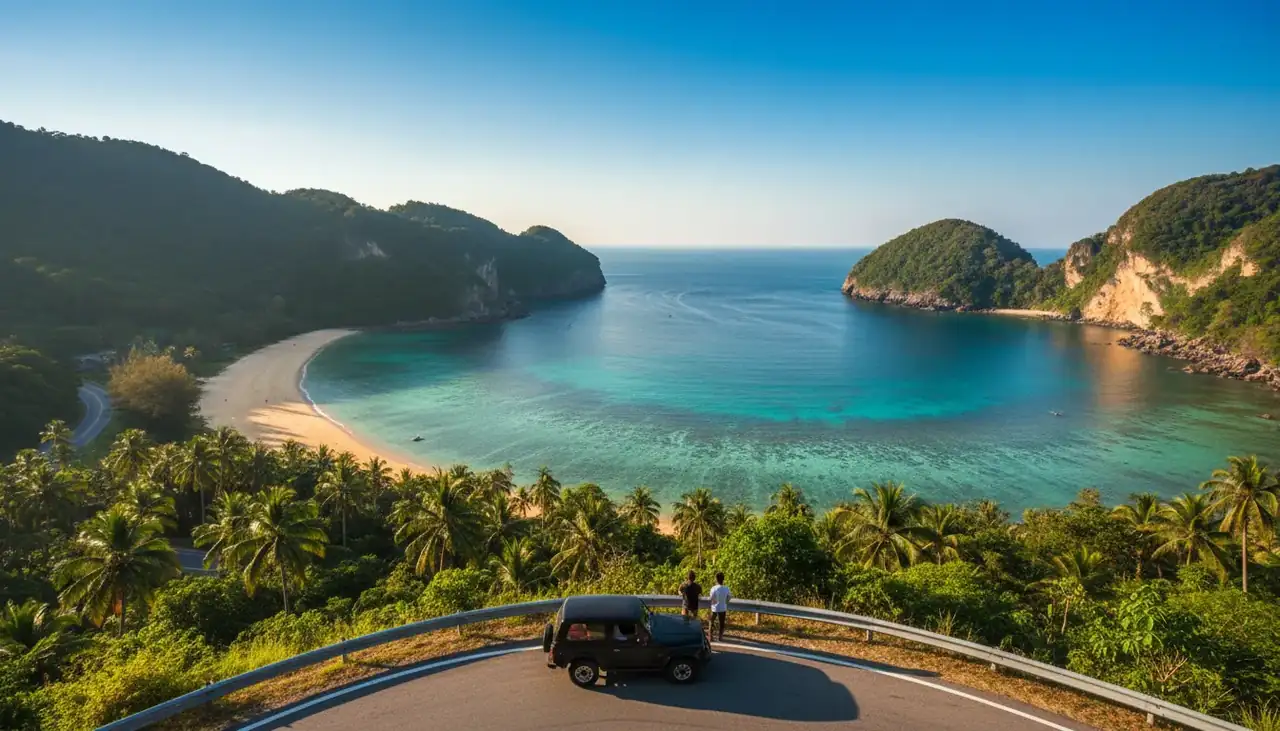
On the island, the spine is Provincial Highway 4245, a paved two-lane road running south down the west coast from Saladan past Klong Dao, Long Beach (Phra Ae), Klong Khong and Klong Nin to Kantiang Bay and Bamboo Bay. From near Klong Nin a branch cuts across the interior to Lanta Old Town on the east coast. The road is in good condition and carries little traffic through the flat northern and central sections. South of Klong Nin the character changes: the road becomes notably steeper, narrower and more winding, with frequent blind bends as it climbs into the limestone hills toward Kantiang Bay and beyond. Visitors have reported that underpowered vehicles — including some 2WD rental cars — struggle on the final steep gradients near Bamboo Bay and the national park approach.
| Destination | Distance from Saladan | Estimated Drive Time | Road Notes |
|---|---|---|---|
| Klong Dao | 2 km | 5–10 min | Flat, congested near the village |
| Long Beach (Phra Ae) | 5 km | 10–15 min | Flat, roadside pedestrian traffic |
| Klong Nin | 15 km | 25–30 min | Flat to gently rolling, blind resort driveways |
| Kantiang Bay | 22 km | 40–45 min | Steep gradients and narrow bends begin south of Klong Nin |
| Lanta Old Town (east coast) | ~17 km via cross-island road | 25–30 min | Paved, sweeping curves, some elevation changes |
| Mu Ko Lanta National Park | ~30 km | 50–60 min | Severe inclines, partly rough, weather-dependent |
Before heading south, rent a car in Saladan rather than a scooter if you plan to reach the steep southern beaches — underpowered two-wheelers genuinely struggle on the hills near the national park.
- Scooters everywhere — they weave, pass on the inside and U-turn without warning
- Dogs resting on the warm tarmac, especially at night — they rarely move for traffic
- Monkeys near the national park that cross without warning
- Unlit roads south of Klong Dao — true darkness after sunset
- Monsoon potholes and wheel ruts that can appear within days of heavy rain
- Localized flash flooding on the southern stretch during the southwest monsoon (May–October)
- Sand patches on beach-access tracks that reduce grip for cars and scooters alike
Thailand's Driving Rules
Thailand drives on the LEFT in right-hand-drive vehicles; overtake on the right. Speed limits in urban and built-up areas run 50–60 km/h; on ordinary rural highways the limit is 80–90 km/h. On Ko Lanta these higher limits are largely theoretical — road conditions rarely permit speeds above 50 km/h south of Klong Nin, and local police checkpoints focus on licensing, alcohol and seatbelts rather than radar.
The 13th Amendment to Thailand's Land Traffic Act, fully in force since 2025, quadrupled fines for the most common offences. The changes are real and enforced: Royal Thai Police began the Safe Roads Project in June 2025 with active stops across tourist areas in Krabi Province, including Ko Lanta. The table below covers what matters most for rental-car drivers.
| Offence | Fine (THB) | Notes |
|---|---|---|
| Speeding | Up to 4,000 | License point deduction also applies |
| No seatbelt — front passenger | 2,000 per person | Mandatory for all seats since 2022 |
| No seatbelt — rear passenger | 2,000 per person | Officers check rear seats at stops |
| No child safety seat (under 6 / under 135 cm) | 2,000 | Reserve a seat in advance; rental stock is limited |
| Handheld phone while driving | 4,000 | Enforced even at traffic stops |
| Drink-driving (BAC over 0.05%) | 5,000–20,000 + suspension | First offence; under-20s face a 0.02% limit |
| Running a red light / failure to yield | 4,000 | Also carries demerit points |
Refusing a breath test at a checkpoint is treated as an admission of drink-driving and carries the same penalty — 5,000–20,000 THB plus licence suspension.
Seatbelts are mandatory for every occupant, front and rear. The child seat law has been in force since 2022: any child under 6 years old or under 135 cm must be secured in an approved child safety seat. Rental agencies carry a limited number — book yours when you reserve your car on Ko Lanta. Headlights must be on at night and during heavy rain; on unlit southern roads this is essential, not optional.
The International Driving Permit (IDP)
Under Thai law, foreign tourists must carry a valid International Driving Permit alongside their original home licence. The IDP is not a standalone document — it is a translation booklet that has no legal force without the original licence beside it. Thailand recognizes both the 1949 Geneva Convention and the 1968 Vienna Convention formats, but the convention that applies depends on your home country. Carry the format that matches your own country's ratification, and note that Thailand caps tourist IDP validity at 90 days per entry regardless of the permit's stated duration.
- United States, Canada, Australia, New Zealand, Japan — 1949 Geneva Convention IDP. US: issued by AAA or AATA (~$20). Canada: CAA (~$25 CAD). Australia: state motoring clubs such as NRMA (~$40 AUD).
- United Kingdom — 1968 Vienna Convention IDP, available from the Post Office or AA (~£5.50). Carry it with your UK photocard licence.
- Most EU countries, Russia, Brazil, India — 1968 Vienna Convention IDP from your national motoring authority.
- Always carry your original national licence alongside the IDP — neither document is valid without the other.
The police fine for not presenting a valid IDP at a checkpoint (1,000–2,000 THB) is the least of your problems. If you are involved in a crash while driving without a valid IDP, your rental insurance and travel insurance will both be voided — leaving you personally liable for vehicle damage, third-party medical costs and property claims that can run into hundreds of thousands of baht. Get the IDP before you travel; it cannot be obtained in Thailand.
If your licence is from a country not listed above, check with your national motoring club before departing. The UK Foreign Office explicitly warns that driving without a valid licence or permit in Thailand could invalidate your travel insurance — the same principle applies to every nationality.
Checkpoints & What to Do in an Accident
Police checkpoints are common throughout Krabi Province and on Ko Lanta itself. On the mainland approach, expect stops along Highway 4 between Krabi and the Ban Hua Hin ferry pier. On the island, checkpoints appear near the Siri Lanta Bridge on Ko Lanta Noi, at the southern edge of Saladan, and periodically along the main beach road. They intensify at night and during Thai public holidays such as Songkran and New Year.
When you reach a checkpoint, slow down well in advance, roll down your window, and have your home licence, IDP and passport ready to hand over together. Stay in the car unless the officer asks you to step out. Keep the interaction calm and polite — officers are checking for licensing, seatbelts, alcohol and vehicle documents (the square windshield tax decal that shows your rental carries Por Ror Bor insurance). Never offer money to an officer: attempting to bribe Thai police is a serious criminal offence that can turn a routine stop into an arrest.
If you are in an accident
- Do not move the vehicles — unless they pose an immediate danger to life, leave them exactly where they stopped. Moving a vehicle can be treated as tampering with the scene.
- Switch on your hazard lights and get yourself and passengers to safety at the roadside.
- Call 1155 (Tourist Police, English-speaking) for assistance, 1669 for ambulance/EMS, or 191 for general police.
- Photograph everything immediately: vehicle positions, licence plates, road context, damage, and the other driver's ID and insurance documents.
- Notify your car rental company — they will dispatch an insurance representative to handle negotiations with the other party's insurer.
- Do not sign any Thai-language documents you cannot read in full, and do not agree to an on-the-spot cash settlement before your insurer is involved.
- Do not admit fault or argue about liability at the scene.
Every vehicle in Thailand must carry Por Ror Bor (พ.ร.บ.), the compulsory third-party liability insurance under the Motor Vehicle Victims Protection Act. Por Ror Bor covers people, not property: it pays initial medical costs up to ~30,000 THB on a no-fault basis, rising to ~80,000 THB if you are proven not at fault, and up to ~500,000 THB in death or permanent-disability cases. It covers zero vehicle damage. This is why the rental's voluntary comprehensive (Class 1) insurance — and your own valid IDP that keeps it active — matter so much.
Car vs Scooter on Ko Lanta
Scooters dominate Ko Lanta's rental market at 200–300 THB per day, and the island is widely considered one of Thailand's gentler places to ride — the main road is wider and less steep than Koh Tao or parts of Phuket, and traffic is light in the north. For short beach hops between Klong Dao and Long Beach, a scooter is nimble and cheap to park.
But there is an honest case for renting a car, and it is a strong one for many visitors. A car rental on Ko Lanta runs roughly 1,200–1,800 THB per day — split between two or more people it closes quickly on the price gap with two scooters. You get air conditioning across a 30-km island in tropical heat, luggage space, doors, airbags, and anti-lock brakes.
- Families with children — the child seat law makes transporting under-6s on a scooter illegal and dangerous
- Two or more people sharing costs — often cheaper than two scooters combined
- Luggage, beach gear or groceries — a scooter basket handles very little
- Monsoon rain — sudden violent downpours make scooter riding miserable and dangerous on slick roads
- The steep southern hills — underpowered 125cc scooters carrying two adults genuinely struggle south of Klong Nin, and some 2WD cars have also needed replacing near Bamboo Bay
- Limited or no riding experience — Ko Lanta is gentler than most Thai islands, but left-side driving on an unfamiliar scooter is still a real hazard
Thailand has one of the world's highest road-death rates: WHO data for 2021 records 25.4 deaths per 100,000 population — roughly 50 fatalities every day. Motorcyclists account for 83.8% of all road traffic deaths. This is not an abstraction: motorcycle accidents are the leading cause of tourist injury and death throughout Thailand, including Krabi Province.
One more thing that the scooter rental shops on Ko Lanta rarely mention: riding a scooter without a motorcycle endorsement on your home licence — and a matching Category A endorsement on your IDP — is illegal in Thailand and will void your travel and rental insurance after any crash, regardless of fault. A standard car licence does not cover powered two-wheelers. Many visitors find out only after an accident. Compare your car rental options here and factor in the true cost of both choices.
Fuel & Parking
Fuel infrastructure on Ko Lanta is concentrated in the north. There is a PTT station near Klong Dao and a Shell in Saladan, with smaller stations at Klong Khong, Klong Nin and Kantiang Bay. None are 24-hour. South of Klong Nin, formal stations disappear and fuel is sold only from roadside bottle stalls — unverified, potentially contaminated fuel that is fine for a scooter but inadvisable for a modern fuel-injected rental car. Fill up completely in Saladan before heading south. Pump prices run approximately 35–45 THB per litre.
- Saladan — Shell station and PTT near Klong Dao; fill up here before any southern trip
- Klong Khong / Klong Nin — small stations open daytime hours only
- South of Klong Nin — roadside bottle vendors only; do not rely on these for a rental car
- Parking is free and informal island-wide: beach clearings, roadside verges, restaurant frontages
- Lanta Old Town — dedicated car parking near the roundabout and pier; park and walk the main heritage street
- Mu Ko Lanta National Park — formal paved lot at park headquarters; vehicle entry fee 30 THB on top of the person entrance charge
- Saladan pier area — limited street parking; arrive early in high season
Download offline Google Maps for Ko Lanta before leaving your hotel — mobile data signal weakens south of Kantiang Bay and can drop entirely near the national park. Google's offline mode retains driving directions and voice navigation even without a signal.
Frequently Asked Questions
Do I need an IDP to drive on Ko Lanta?
Is it safe to drive on Ko Lanta?
What side of the road does Thailand drive on?
Car or scooter — which is better for Ko Lanta?
What happens if the police stop me on Ko Lanta?
Where can I buy fuel on Ko Lanta?
Ready to compare car rental deals in Ko Lanta?
Check live prices and availability from local and international suppliers.
Compare car rental deals